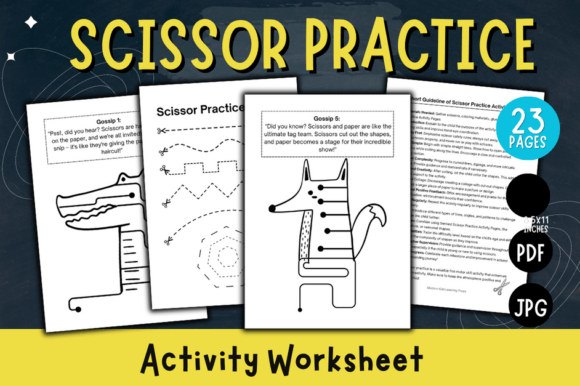
Scissor Practice Activity Worksheet: A Design Asset for Precision
In the intricate world of design, where every pixel and curve communicates a message, foundational skills often hold the key to innovation. A Scissor Practice Activity Worksheet, while seemingly simple, embodies the core principles of precision, line control, and spatial awareness that are vital for any creative professional.
The Foundation of Visual Control and Brand Consistency
This worksheet is more than a childhood exercise; it's a metaphor for the meticulous craft required in graphic design. The act of following a line to cut a shape directly parallels the designer's task of creating clean vector paths, maintaining consistent brand elements, and executing a logo with flawless symmetry. For those in branding and logo design, understanding how to manipulate simple forms is the bedrock of building a strong, recognizable identity. The worksheet's structured approach reinforces the discipline needed to ensure every visual touchpoint, from a business card to a billboard, aligns perfectly with the established brand guidelines.
Practical Applications Across Creative Projects
The principles honed through such focused practice are directly transferable to a multitude of design disciplines. Consider how this foundational skill set enhances various creative outputs:
- Typography and Editorial Design: Precise cutting is akin to kerning and leading—adjusting the invisible spaces between letters and lines to achieve perfect readability and visual flow. It cultivates an eye for the negative space that gives text room to breathe.
- Packaging and Print Design: Designing for physical products requires an intimate understanding of how flat designs translate into three-dimensional forms. The spatial reasoning developed through cutting activities is crucial for creating effective dielines and ensuring graphics align flawlessly on assembled packages.
- UI/UX and Web Design: In digital interfaces, every icon, button, and component must be crafted with pixel-perfect precision. The hand-eye coordination and fine motor skill development from such practice contribute to a designer's ability to create clean, intuitive, and visually cohesive user interfaces.
- Marketing and Social Media Graphics: Creating compelling visual content for fast-paced platforms demands both speed and accuracy. The ability to quickly execute clean cut-outs, custom shapes, and dynamic layouts is enhanced by a deep-seated understanding of form and composition.
Integrating Foundational Assets into Your Design Workflow
When selecting or creating visual assets for any project, the core tenets of good design must guide your choices. A well-considered asset, whether a complex illustration or a simple geometric shape, should demonstrate:
- Scalability: Like a well-cut shape, quality design assets must function across sizes without losing integrity, from a favicon to a hero image.
- Visual Hierarchy: The principles of focus and arrangement are paramount. Every element should guide the viewer's eye intentionally, much like a cutting guide directs the scissors.
- Consistency: A unified system of shapes, colors, and typography builds trust and recognition. This consistency is the direct result of disciplined, precise execution.
- Audience Alignment: The style and complexity of your visual language must resonate with your target user, balancing creativity with clarity.
Ultimately, the most impactful design is born from a blend of creative vision and disciplined execution. By valuing and practicing the fundamental skills that underpin all visual communication—precision, control, and an understanding of form—designers and creators can elevate their work from merely attractive to truly effective. Quality creative assets are not just decorative; they are the tools that enable this elevation, ensuring every project communicates with professionalism, clarity, and aesthetic intention.